
A sauna heater maintained on a simple, low-cost routine, rinsing and restacking stones every few months, checking vents and clearances for dust and debris, and replacing the stone set once a year or two, will typically run 8 to 12 years before the elements need replacing. Skipping that routine is the single biggest reason a budget heater fails in half that time, and the maintenance itself costs almost nothing beyond a little regular attention.
Why Stone Care Is the Highest-Value Habit
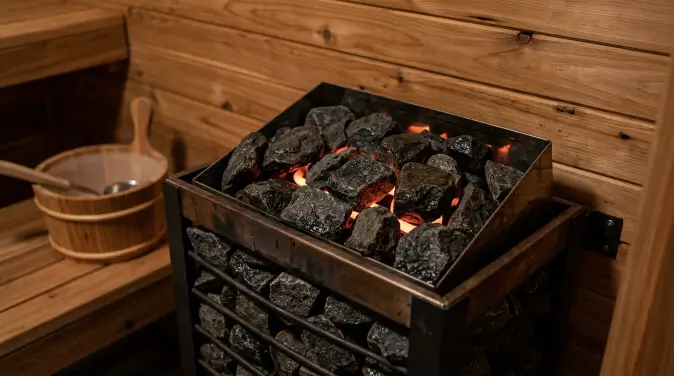
Stones absorb mineral deposits from water poured over them for steam, and over time that buildup, along with small cracks from repeated heat cycling, restricts airflow around the heating elements underneath. A heater working against blocked airflow runs hotter and longer to reach the same temperature, which shortens element life the same way an undersized heater does. Rinsing stones every two to three months and pulling out any cracked or crumbled pieces takes a few minutes and costs nothing, making it the best return on effort of any maintenance task on this list.
How Often to Replace the Full Stone Set
Even well-maintained stones eventually crack from thousands of heat cycles and need full replacement, typically once a year for daily-use heaters and closer to every two years for lighter, occasional use. A full stone set generally costs far less than a service call, which makes this one of the cheapest recurring maintenance items in sauna ownership. Buying stones sized correctly for your specific heater model matters here, since undersized or oddly shaped stones stack poorly and create the same airflow problems as old, cracked ones.
Keeping Vents and Clearances Clear
Dust, lint, and stray debris around the heater’s air intake and exhaust vents force it to work harder to circulate heat properly, which is an easy thing to overlook since it builds up gradually. A quick visual check every month or two, and a light vacuum of visible dust near the base, keeps airflow where the manufacturer designed it to be. This costs nothing but a few minutes and is one of the simplest ways to avoid a heater running inefficiently long before anything actually breaks.
Watching the Thermostat and Timer
A thermostat that overshoots, undershoots, or takes noticeably longer than it used to reach target temperature is often the first sign of a heater under strain, whether from stone buildup, a failing sensor, or an element starting to go. Catching this early, rather than running the heater at its limit for months, is what actually protects the elements from a full failure. Noting how long a session normally takes to reach temperature, and paying attention when that time creeps up meaningfully, is a free early-warning system most owners never think to use.
What Actually Shortens a Heater’s Life the Fastest
Running a heater dry with no water ever added to the stones, in models designed to accept it, ignoring cracked stones for a full season, letting dust accumulate around vents, and using the heater well beyond a struggling thermostat’s obvious warning signs are the habits that cut a heater’s working life the most. None of these cost anything to avoid, which makes heater longevity mostly a matter of a few minutes of attention rather than money spent. A heater bought on a tight budget and properly maintained will often outlast a pricier one neglected the same way.
See also: How to Generate Consistent Leads for Your Business
When Replacement Actually Makes More Sense Than Repair
Element replacement on most home heaters is a modest repair, often a fraction of a new heater’s cost, and worth doing on a unit that is otherwise sound. Replacement starts to make more financial sense once the housing itself is corroded, the thermostat has failed more than once, or the heater is already well past its typical service life of 8 to 12 years. Checking listed heater prices against a repair quote, including current models at sweatdecks.com/collections/sauna-heaters, before committing to either path is a fast way to confirm which option actually saves money on an aging unit.
What the Evidence Says About Consistent Sauna Use
A well-maintained heater matters for more than avoiding a repair bill, since the research on sauna bathing generally describes consistent, regular sessions rather than occasional ones. A review in Mayo Clinic Proceedings summarized associations between frequent sauna use and favorable cardiovascular outcomes across multiple cohort studies. A systematic review in Evidence-Based Complementary and Alternative Medicine reported broadly similar associations for regular dry sauna bathing. An earlier review in The American Journal of Medicine reached comparable conclusions decades before those newer studies. These findings describe population-level associations, not a guarantee for any one person, but they assume a heater that keeps working reliably session after session, which is exactly what a simple maintenance routine protects.
Warning Signs the Heating Element Itself Is Failing
A session that suddenly takes noticeably longer to reach normal temperature, a heater that trips its breaker more than once, or an element glowing unevenly rather than uniformly are the clearest signs an element is nearing the end of its life rather than just needing a stone refresh. Catching these signs early and scheduling a straightforward element swap is far cheaper than waiting for a full failure mid-season, which can also stress the thermostat and wiring around a dying element. Most of these symptoms show up gradually over weeks, which is exactly why noting your heater’s normal warm-up time is useful: a slow drift away from that baseline is the earliest and cheapest warning available.
Checking the Electrical Connections Without Doing Electrical Work
A homeowner can safely do a visual check of the connection box and control panel exterior, looking for discoloration, a burning smell, or a loose cover, without touching any wiring. Any of those signs is a reason to call a licensed electrician promptly rather than waiting, since a heater’s electrical connections carry meaningful current and a developing fault there is a fire risk, not just a performance issue. This kind of visual check costs nothing and takes under a minute during a normal stone rinse, making it worth folding into the same routine rather than treating it as a separate task that gets skipped.
Frequently Asked Questions
How often should sauna heater stones be replaced? Rinse every few months and replace the full set roughly once a year or two, depending on use frequency.
What is the cheapest maintenance step that extends a sauna heater’s life the most? Keeping the stone bed properly loaded and rinsed, since buildup restricts airflow and stresses the elements.
Do sauna heater elements wear out no matter what? Yes, typically after 5 to 10 years, but poor stone care or ignoring thermostat problems can shorten that significantly.
Is it worth paying for a professional heater inspection? Usually not for routine checks, but worthwhile if the heater cycles oddly or trips breakers.
References
- Benefits and risks of sauna bathing, The American Journal of Medicine, 2001
- Clinical Effects of Regular Dry Sauna Bathing: A Systematic Review, Evidence-Based Complementary and Alternative Medicine, 2018
- Cardiovascular and Other Health Benefits of Sauna Bathing: A Review of the Evidence, Mayo Clinic Proceedings, 2018
By Miguel Santoro